







Remember that course in college when you said, "Wow! That was incredible. I can't believe how much I learned." Then there was that other class that left you feeling flat, bored, and not sure that you learned a thing. Or the time your spouse loved the well constructed, carefully outlined talk that was accompanied by succinct power point slides of the key points—but you yawned the whole time.
Why these differences?
Maybe it's clashing learning styles. Whether you were aware of it or not, differences in learning styles have probably caused some frustration or a lack of understanding in your small group. Of course, the personality, expertise, and enthusiasm of the group leader does make a difference. So does the nature of the content. But learning styles are a key factor that plays into these tensions, and their significance may not be intuitive for many of us.
So What Is a Learning Style?
A learning style is simply how one perceives and processes information. And we all do that differently. That's the rub, and what makes an awareness of learning styles important for those involved with small groups. Let's go back to the definition. To perceive information refers to the way we take in data: through our senses. One person may do it best visually, another through hearing, yet someone else may prefer to be actively involved.
Then there is the processing aspect. That's what the brain does with the information after it has been perceived. Here again are significant differences. Information may be split into parts, organized, clumped together, analyzed, manipulated—any number of things. Most of us can do all these forms of perceiving and processing, but when it comes to learning, we tend to have preferences. The way we learn, especially in our early years, can influence our personality. How we learn matters.
Currently there are many models of learning styles. Some have to do with the influence of environmental factors, such as lighting or type of seating; others relate to influences on body rhythms, like time of day or the season.
One that I find particularly helpful deals with the cognitive and affective aspects of learning—how I think and feel about my learning. David Kolb developed the model in the late 70's, and shortly thereafter Bernice McCarthy contributed insights regarding the affective components of learning. The work of these two educators informs much of this article.
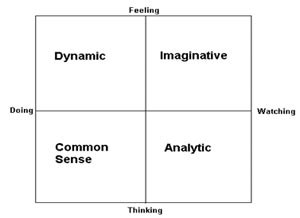
Kolb's model can be represented by a grid with two axes: one horizontal, the other vertical. The vertical axis has feeling (concrete experience) at the top and thinking (abstract conceptualization) at the bottom; the horizontal axis has doing (active experimentation) on the left and watching (reflective observation) on the right. The two axes intersect, creating four quadrants.
The top right quadrant represents imaginative or innovative people who like to diverge in their thinking (type 1 learners); the bottom right is analytic, representing those who assimilate facts (type 2); the bottom left quadrant is common sense for those who converge their learning (type 3); and the top left signifies dynamic people who experiment (type 4).
Characteristics of Learning Styles
First of all, no one is purely one type of learner. We're all a mix of types, but most of us have a style of learning with which we are most comfortable. By the way, intelligence is equally distributed among all styles.
Here are brief summaries that describe each type:
- Imaginative. Starts with concrete reality and then diverges creatively. Enjoys the arts and beauty. Learns through discussion and interaction. Friendly and caring. Enjoys people. Dislikes lectures, competition, and debate. May be a people pleaser. Needs to feel liked and accepted to learn well. Asks "why?" Typecast ministry position: pastoral counselor, youth ministry.
- Analytic. Starts with ideas and abstractions. Assimilates content like a sponge. Organizes it into theories and concepts. Learns well from organized experts. Wants all the facts. Serious minded. Tends to like ideas more than people. Dislikes discussion, noise, and sitting in circles. They love school because traditional school is designed for this type. (That's the reason so many teachers and professors are like this: because they are in an environment very comfortable for them.) Asks "what?" Typecast ministry position: systematic theologian, expository preacher.
- Common Sense. Starts with ideas and concepts but then converges them to develop a plan or strategy. Enjoys figuring out how things work. Hands-on. Dislikes lectures, memorizing, lots of reading, and being told how to do something. Focuses on tasks sometimes to a fault. Asks "how?" Typecast ministry position: practical theology, administration.
- Dynamic. Starts with concrete experience and accommodates through trial and error. Experiments, takes risks. Very flexible. Change agent. Enjoys learning in a variety of ways. Dislikes routine and "rigid" truths. May be comfortable in front of people. Asks "so what?" and "what if?" Typecast ministry position: pioneer missionary, evangelist.
Learning styles vary greatly. Those differences can be challenging for a small-group member, or they can make community experiences rich and fulfilling—it all depends on your perspective. In some ways, the style differences remind me of the diversity of spiritual gifts described in the New Testament; they also parallel the diversity of the Body of Christ noted in 1 Corinthians 12. You wouldn't want a small group made up only of people who are analytic, Type 2 learners any more than you'd want a body made up of only hands.
A small group of diverse learners is complementary, sort of like a marriage. The differences in members' styles can help each other develop their strengths and also grow in areas of weakness. Diversity is healthy and, I think, draws on biblical principles.
Relevance for Leaders
Why should small group leaders be aware of learning styles? Because you need to be aware of your own learning preferences. Know your strengths, but also be aware of ways of learning that make you uncomfortable—the method or approach you tend to avoid as a leader. Most of us prefer to do what makes us comfortable. But what I dislike in a learning setting may be exactly what would help another—usually a person whose style is opposite mine—to gain insight into a spiritual truth.
For example, Imaginative learners may focus so much on relationships within the group and issues in their lives that they fail to spend an adequate amount of time on the content. Analytic learners may be so text focused that the group struggles to get to know each other well. Common Sense learners may be so task oriented—even with caring, servant tasks—that relationships or Scripture may be neglected. And Dynamic learners may be so flexible that truth may become relative.
As in most of life, sameness is not best.
How to Use Learning Styles
Here's how I've applied the concept of learning styles to my own group leading and teaching. First, I don't worry about the style of the people in my group or class. Fully aware of my own weaknesses and preferences, I intentionally try to introduce an activity or experience that's relevant for each learning style at some point in every session, even if it's brief. That way, every person feels comfortable at some point, which then helps them be willing to be stretched in methods or styles that are not their strength.
Several years ago I came up with five-steps that help me plan lessons. I call them the "5 -Ates to Educate." (The term educate, by the way, does not mean to teach or to learn; it means to draw out or to lead. Think about how that definition might affect your role as a group leader.)
The five steps are Locate, Elaborate, Illuminate, Integrate, and Activate.
- The Locate step becomes the aim of the lesson and relates to a felt need or problem facing the learners.
- The Elaborate step takes that problem and pushes it to its logical conclusion if there is no resolution to it. Imaginative learners enjoy doing this kind of creative thinking.
- The Illuminate step brings people to the text—whether the Bible or another book being studied—to examine the content for the truths and facts. Analytic learners thrive here.
- The Integrate step then helps apply the truth to the felt need or problem. This application step helps learners devise plans for resolving the life problem identified in the Locate step. Common Sense learners are strong here.
- Finally, the Activate step helps participants become motivated and accountable for living out the truths identified in the Illuminate step. This draws on Dynamic learners' strengths.
Once again, the leader does not need to match learning style type with certain activities. Just let it happen.
I am glad I know about learning styles. I find them so helpful. Yet the model described above is a tool, and only a tool. It's not a panacea for all the problems that arise in small groups.
In addition, there is one more thing that will help you immensely when it comes to learning and spiritual transformation in your small group, regardless of your learning style: time and space for reflection. Time for reflection is essential because it creates the space necessary for you to hear the whispers of the Holy Spirit. After all, it is the Spirit of God who is the true teacher—the one who truly brings about transformation in the lives of your group.
Scottie May is Assistant Professor in the department of Christian Formation and Ministry at Wheaton College.
—Scottie May; copyright 2008 by the author and Christianity Today.